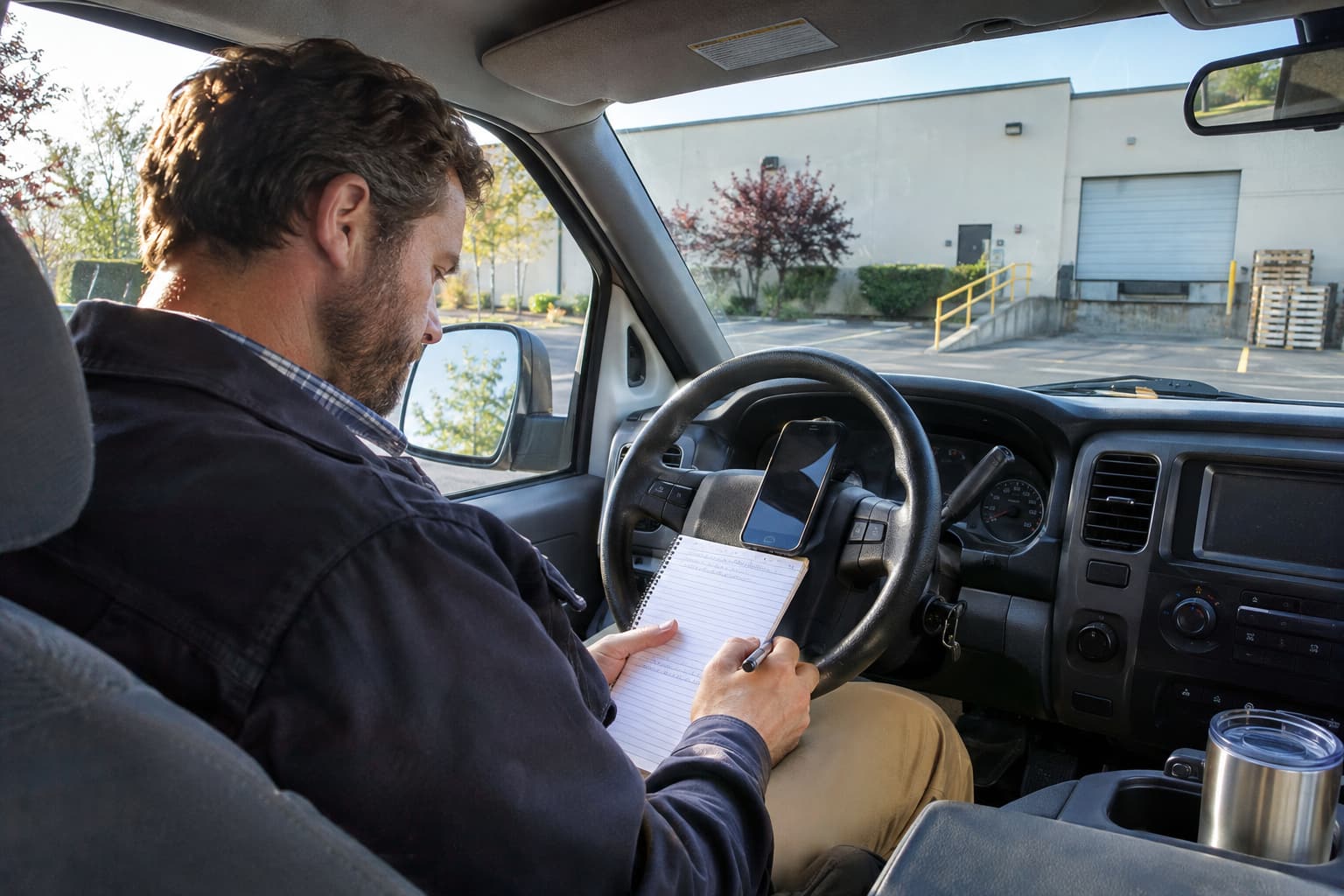
Pre-call planning is the short preparation a rep does before a customer visit: decide what the visit is for, read what happened last time, write the questions, and pack what you need. A field rep can do it in five minutes in the parking lot, and a full one-page plan takes about fifteen for a visit that matters. This guide gives you both, a plan to copy and a filled-in example.
Most pre-call planning advice is written for a salesperson booking a video call with a prospect: research the company website, read their social media, prepare slides. A field rep visiting the same customers again and again has a different job. The customer is often a regular, the research is in your own notes, and the next stop is 20 minutes away. The method below is built for that.
What pre-call planning is, and why it matters
A pre-call plan answers four questions before you walk in. What do I want from this visit? What do I know about this customer? What will I ask? What do I need to have with me? That is all it is. It is not a research project.
It matters for three reasons.
- You stop repeating yourself. A rep who read the last note does not ask a question the customer answered three weeks ago.
- Every visit ends with something. A visit with an objective ends with a result or a clear next step. A visit with none ends with a friendly chat and a normal order.
- You use the customer's time well. Buyers have a few minutes between a delivery and a phone call. A rep who is ready uses them.
Richardson's guide to sales call planning makes the same point: buyers have little time for sales meetings, and preparation builds credibility and trust. Its template runs to eight areas of research, which suits a long enterprise deal. A rep covering 20 stops a day needs a shorter form.
The five-minute version
Do this in the parking lot before you go in. Set a timer on your phone, because the temptation is to spend 15 minutes and be late.
- Read the last note and the last order (1 minute). What did you promise? What did the customer ask for? Did anything go wrong since?
- Pick one primary objective (1 minute). The one thing this visit should achieve, in a sentence. "Get the trial case of the new line into the kitchen."
- Pick one fallback (30 seconds). The smaller result you will take if the primary is not possible. "Agree a date to try it."
- Write two questions (1 minute). Open questions about their business, not yes or no. "What are you selling most of right now?"
- Check what you carry (1 minute). Samples, price sheet, the order you promised, a pen. If something is missing, decide how you will send it.
- Say the opening sentence out loud (30 seconds). Start with something from the last visit, not "just checking in."
Objectives: one primary, one fallback
An objective is a result you can check afterward, not an activity. "Build the relationship" is an activity. "Leave with the owner's agreement to trial the new line" is a result. Write it so you can tell, at the next stop, whether you got it.
Joe Girard's four-step plan suggests preparing more than one next step for every call: a primary, a smaller secondary step, and a third one such as another meeting with a specific goal. In a field route the same idea fits two levels. The primary is the result you want. The fallback is the smaller step that still moves the account forward.
| Visit | Primary | Fallback |
|---|---|---|
| Regular account, slow quarter | Find out why the cleaning supplies order stopped | Get the buyer's name for who decides it |
| New product | A trial order of one case | A date to try a sample |
| Prospect, first visit | Meet the person who orders and learn what they buy now | Leave a price sheet and get an email address |
| Problem visit | Agree what we will do about the short shipment | Agree a time to call back with an answer |
The full one-page plan
Use the full plan for a visit that matters: a large account, a first meeting with a decision maker, a customer who is unhappy. Fifteen minutes the evening before, or in the morning before the route starts, is enough. Indeed's pre-call planning guide lists five steps: research the buyer, research competitors, set an objective, write questions and anticipate objections. The plan below keeps all five and adds the two a field rep needs most, what you promised last time and what you carry.
Customer: ______  Contact: ______  Date and time: ______  Type: prospect / regular account / problem visit
Last visit: ______ (date)  What we agreed: ______  What I promised: ______
Last 3 months of orders: up / flat / down  Notes: ______
Open issues: ______
Primary objective (a result I can check): ______
Fallback objective: ______
Questions to ask (open, about their business):
  1. ______
  2. ______
  3. ______
What they may say no to, and my answer: ______
Competitors in the account, if known: ______
What I bring: samples ______  price sheet ______  promised item ______  other ______
Opening sentence: ______
Next step I will ask for: ______
Questions to ask
A good question makes the customer talk about their business and not your product. Write two or three before you go in.
- "What has changed in your business since I was last here?"
- "What are you having trouble getting right now, from us or anyone else?"
- "What is selling best for you, and what is sitting?"
- "What would make you order more from us?"
- "Who else decides on this?"
Avoid questions with an obvious answer, such as "Do you want to save money?" Ask about the customer's own customers and their own problems.
What to bring
Keep a standard kit in the truck and add the specifics for each visit. The kit is the price sheet, a current catalog, order forms, samples of your best two or three lines, business cards and a pen. The specifics are the thing you promised last time, the product the customer asked about, and any credit or paperwork that was open. Walking in without the item you promised is worse than walking in without a plan.
How the plan changes by visit type
The same form works for all three. What you put in it is different.
| Prospect | Existing account | Problem visit | |
|---|---|---|---|
| What you read first | What you can see: their location, what they sell, who else supplies them | The last note, the last three months of orders, open issues | The complaint in the customer's own words, and what happened inside your company |
| Primary objective | Meet the person who orders and learn what they buy now | Move one thing forward: a trial, a reorder, a new site | Agree what you will do about it, and when |
| Tone of the opening | Short and curious, one sentence on who you are | Pick up from last time | Listen first, say sorry once if you were at fault, then fix |
| What you bring | Price sheet and one or two samples | What you promised, plus one new thing | A decision you are allowed to make, such as a credit or a replacement |
| Fallback | Contact details and permission to return | A date for the next step | A time you will call back with an answer |
For a problem visit, the most useful preparation is to find out what happened before you arrive. Ask the office, the driver and the warehouse. Know which decisions are yours to make. A rep who arrives without an answer has to promise to find one.
Customer: Eastside Deli  Contact: Priya, owner  Date and time: Thursday 10:30  Type: regular account
Last visit: two weeks ago  What we agreed: she would think about a second case of the olive oil  What I promised: a price on the larger tin
Last 3 months of orders: down  Notes: no paper goods order in five weeks
Open issues: one short shipment on the last delivery, credit not yet issued
Primary objective: find out why paper goods stopped and get an order or a reason
Fallback objective: get the name of the supplier who took it
Questions to ask:
  1. What changed with paper goods?
  2. What is selling best at lunch right now?
  3. Who orders when you are away?
What they may say no to, and my answer: the larger tin at last week's price. Hold it if the order is two cases.
What I bring: samples of the new napkin  price sheet  the larger-tin price  credit slip for the short shipment
Opening sentence: I brought the price on the big tin, and I want to fix the shortage on the last delivery.
Next step I will ask for: a trial order of napkins on Monday's delivery
After the visit
Planning only pays off if the next plan can use what you learned. Before you drive to the next stop, write down three things: whether you got the primary objective, what the customer said that you did not expect, and what you now owe them. Two sentences are enough. Then do what you promised, on the day you promised it.
For a fuller record, use a customer visit report after a visit that mattered, or a sales call report when a manager wants a standard form across the team. The plan and the report are two ends of one visit, and the answers in the second are the starting point of the next plan.
What managers can do
If you manage reps, do not ask for a written plan for every visit. You will get filled-in forms and no better visits. Ask for it in three cases: a first meeting with a prospect that could be large, a problem visit, and any account in a key account plan. Use the plan in a ride-along or a weekly coaching talk. Ask the rep to read you the primary objective and the fallback, and then ask how the visit went against them. That conversation teaches more than the form does, and coaching field reps covers how to run it.
Where reps work a repeating route, the visit rhythm is already set by a call cycle. Pre-call planning is what makes each slot in the cycle count.